Best Dental Clinic In Bangalore Indiranagar | Best Dentist in Bangalore Indiranagar

WPT Laser Gum Therapy: A Safer, Painless Solution for Healthy Gums
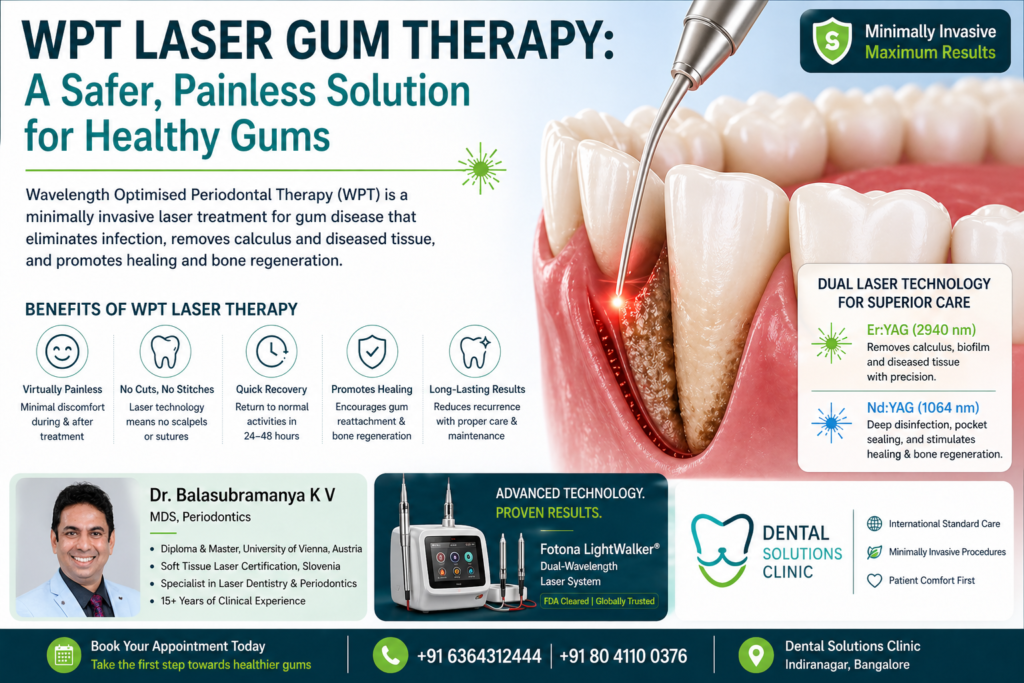
For most people, the words “gum surgery” conjure an immediate sense of dread—scalpels, stitches, swelling, and weeks of painful recovery. It is a fear that keeps far too many patients from seeking treatment for a condition that, if left untreated, does not stay confined to the gums. Advanced gum disease erodes the bone supporting your teeth, contributes to systemic health problems, including heart disease and diabetes complications, and ultimately leads to tooth loss.
The good news is this: gum surgery, as most people imagine it, is no longer the only option.
Wavelength-Optimised Periodontal Therapy—known as WPT—is a minimally invasive, clinically proven, and virtually painless laser-based approach to treating gum disease. At Dental Solutions Clinic, Indiranagar, it is one of the most advanced and sought-after procedures we offer, performed by Dr. Balasubramanya K.V.—one of Bangalore’s most experienced periodontists and laser dentistry specialists, with a diploma and master’s from the University of Vienna and soft tissue laser certification from Slovenia.
This blog explains what WPT laser gum therapy is, how it works, what you can expect during and after treatment, and why it represents a genuine leap forward in the treatment of gum disease.
Understanding Gum Disease: The Problem WPT Solves
Before understanding the solution, it helps to understand the condition it addresses.
Periodontal disease — commonly called gum disease — is an inflammatory condition that affects the gums and the supporting bone structure that holds teeth in place. It begins silently. Dental plaque — a sticky, bacteria-laden biofilm that forms continuously on the surfaces of teeth — accumulates along the gum line. When not effectively removed through brushing and flossing, this plaque hardens into calculus (tartar), which cannot be removed at home and triggers a persistent inflammatory response in the gum tissue.
In its early stages, gum disease is called gingivitis: the gums become red and swollen, and they tend to bleed when brushed. Many patients dismiss this as normal. It is not. Left unaddressed, gingivitis progresses into periodontitis—a far more serious condition in which the gum tissue begins to pull away from the teeth, forming deep pockets that fill with bacteria and infection. The inflammation spreads to the underlying bone. The bone begins to dissolve. Teeth loosen. Eventually, without intervention, they are lost.
The human body’s response to this process creates a cruel cycle: as the body increases blood flow to the gums to fight infection, the gum tissue swells—but between teeth, there is very little space for blood vessels to move in and out. The result is that the supporting bone itself dissolves to make room, accelerating the very destruction the immune response was trying to prevent.
Periodontal disease is the leading cause of tooth loss in adults in India. And its impact extends beyond the mouth—research consistently links untreated periodontitis to increased risk of cardiovascular disease, poor glycaemic control in diabetics, adverse pregnancy outcomes, and respiratory infections.
Risk Factors for Gum Disease
Common risk factors include poor oral hygiene, tobacco use, uncontrolled diabetes, genetic predisposition, certain medications that reduce saliva flow, hormonal changes during pregnancy, and immune system disorders.
What Is WPT Laser Gum Therapy?
Wavelength-Optimized Periodontal Therapy (WPT™) is a minimally invasive laser treatment for periodontal disease that uses the combined power of two highly effective laser wavelengths—Er: YAG (2940 nm) and Nd: YAG (1064 nm)—to eliminate infection, remove calculus and diseased tissue, and create the optimal biological conditions for gum healing and bone regeneration.
Rather than using a scalpel to cut the gums, WPT employs a thin quartz fibre laser—no wider than a fine needle—that is gently guided between the tooth and the gum line. Each laser wavelength is deployed for the task it excels at: together, they perform comprehensive cleaning and decontamination of the periodontal pocket that traditional approaches cannot match.
WPT is part of the Fotona TwinLight® Periodontal Treatment system—a globally recognized, FDA-cleared, evidence-based approach to laser periodontal care that uses the LightWalker dual-wavelength laser platform. At Dental Solutions Clinic, this technology is in the hands of Dr Balasubramanya K V, whose specialist training in laser dentistry and periodontics gives patients the highest standard of care available in Bangalore.
The Science Behind WPT: Two Lasers, One Powerful Treatment
The defining characteristic of WPT—and the source of its clinical superiority over single-wavelength approaches—is its deliberate combination of two laser wavelengths, each optimized for a specific biological task.
Er: YAG Laser—The Precision Cleanser (2940 nm)
The Er: YAG (Erbium-doped Yttrium Aluminium Garnet) laser operates at a wavelength of 2940 nm. This wavelength is uniquely well-matched to the absorption spectrum of water, making it exceptionally effective at the following:
- Ablating (removing) calculus deposits from root surfaces with precise, gentle energy
- Eliminating microbial biofilm — the dense bacterial communities that drive periodontal infection
- Removing infected soft tissue from the inner surface of the periodontal pocket
- Performing this ablation with minimal thermal damage to the surrounding healthy tissue
The Er: YAG laser is the surgical cleanser of the WPT system—precise, efficient, and gentle on structures that need to be preserved.
Nd: YAG Laser—The Deep Disinfectant and Healer (1064 nm)
The Nd: YAG (neodymium-doped yttrium aluminum garnet) laser operates at 1064 nm. This wavelength is particularly absorbed by pigmented bacteria and soft tissue, making it the ideal tool for:
- Destroying the diseased epithelial lining of the periodontal pocket
- Deep disinfection—the Nd: YAG penetrates 2–3 mm into tissue, reaching and eliminating anaerobic bacteria that standard cleaning cannot access
- Coagulation — triggering the formation of a stable fibrin clot that seals the pocket and prevents reinfection
- Biostimulation—the Nd: YAG’s thermal effect stimulates the body’s own healing response, supporting bone regeneration and gum reattachment
Where the Er: YAG cleans, the Nd: YAG disinfects, seals, and heals.
The WPT Advantage: Why Both Wavelengths Together Matter
When combined, these lasers can significantly enhance the outcome of laser-assisted treatments, ensuring maximum safety and efficacy. The TwinLight® approach enables wavelength-optimized treatments for periodontal therapy (such as WPT™), which create the optimal conditions for healing periodontal tissues. Neither wavelength alone achieves what both together accomplish. This dual-wavelength synergy is the core of what makes WPT a more complete and clinically superior solution compared to single-laser protocols.
The WPT Procedure — Step by Step
Wavelength-optimized periodontal therapy is carried out in 4 simple steps. Here is what happens during your treatment at Dental Solutions Clinic:
Step 1—Diseased Tissue Removal (Nd:YAG)
The Nd: YAG laser is guided through the periodontal pocket using a fine fibre tip. With a careful sweeping motion from the top to the base of the pocket, the Nd: YAG laser destroys the diseased epithelial lining of the periodontal pocket and improves access to the root surface. This step eliminates the infected tissue lining while preserving the healthy surrounding gum, creating a clean pocket surface and improved access for the next stage.
Step 2—Calculus and Biofilm Removal (Er: YAG)
The Er: YAG laser is now directed at the root surface within the pocket. The Er: YAG is used to remove microbial biofilm and calculus from the root surface. Using gentle up-and-down movements along the root, the laser detects and removes calcified deposits and bacterial biofilm with precision—paying particular attention to preserving the cementum layer of the root, which is critical for future gum reattachment and bone healing.
Step 3—Pocket Sealing and Fibrin Clot Formation (Nd:YAG)
Once the pocket is thoroughly clean and decontaminated, the Nd: YAG laser is used a second time. Nd: YAG laser energy is used to harden and help form a stable fibrin clot. This seals off the pocket and promotes healing and bone regeneration. The fibrin clot acts as a biological seal—closing off the cleaned pocket from the oral environment, preventing bacterial recolonisation, and providing the scaffold for new tissue attachment.
Step 4 — Endotoxin Removal and Final Decontamination
Endotoxins from the root surface and epithelial lining are removed. Endotoxins — toxic compounds released by gram-negative bacteria — are a primary driver of the inflammatory response that destroys periodontal bone. Their removal in this final step ensures the maximum conditions for undisturbed healing and long-term periodontal stability.
What does the procedure feel like? Most patients experience little to no discomfort during WPT. Local anaesthesia is applied before the procedure as needed. The thin laser fibre is guided gently between the tooth and gum—there is no cutting, no stitching, and no significant pressure. Most patients describe the experience as far more comfortable than they anticipated.
WPT vs. Traditional Gum Surgery: The Difference Is Clear
Understanding what WPT replaces helps illustrate its value. The traditional surgical alternative is gingival flap surgery — a procedure in which the periodontist makes incisions in the gum to lift back a section of tissue, exposing the roots and underlying bone for cleaning. Bone may be recontoured before the gum is sutured back into place.
Feature | Traditional Flap Surgery | WPT Laser Gum Therapy |
Incisions | Yes — scalpel cuts required | No — no cutting |
Sutures | Yes — stitching required | No — no stitches |
Pain level | Moderate to significant | Minimal to none |
Anaesthesia | Local (often extensive) | Local (minimal) |
Swelling | Common, often significant | Minimal to none |
Recovery time | 1–2 weeks | 24–48 hours typically |
Visits required | Multiple (surgery + reviews) | 1–2 visits often sufficient |
Tissue preservation | Tissue is cut and repositioned | Healthy tissue preserved |
Bone regeneration | Limited | Supported and promoted |
Infection risk post-op | Higher | Lower — pocket sealed by fibrin clot |
Patient comfort | Significant discomfort expected | High comfort throughout |
The Benefits of WPT Laser Therapy at Dental Solutions Clinic
Patients undergoing WPT™ enjoy several advantages over traditional gum disease treatments. These benefits include: Less invasive treatment. Minimal to no post-procedure pain. Effective results, including gum-tooth reattachment and growth of new dental tissue. Quick recovery time. Reduced recurrence with patient compliance. Furthermore, the WPT™ procedure is typically painless, with little to no swelling.
In detail:
No Scalpels, No Sutures
The entire procedure is performed with a fine laser fibre — no cutting, no stitches, no post-operative wound management. For patients who have avoided gum treatment out of fear of surgical procedures, WPT removes the primary barrier to care.
Virtually Painless Experience
The precision of laser energy means treatment can be performed with minimal local anaesthesia. The procedure itself causes little to no pain during or after. About 75% of patients report significantly less pain compared to traditional gum surgery.
Minimal Recovery Time
Because there are no surgical wounds to heal, recovery is rapid. Most patients return to normal activities within 24–48 hours. There is no need to take extended time off work, avoid speaking, or manage painful post-operative symptoms for days.
Precision Targeting — Healthy Tissue Is Preserved
Safely remove diseased tissues in your gum pocket linings without damaging the healthy ones around it. The laser’s precision means that only diseased tissue is removed. Healthy gum, cementum, and bone are left completely intact — improving both the healing outcome and the long-term aesthetics of the gum line.
Deep Bacterial Elimination
Nd:YAG lasers are particularly effective, penetrating 2–3 mm into the tissue to eliminate anaerobic pathogens such as Porphyromonas gingivalis — both key contributors to periodontal breakdown and bone loss. Standard scaling and root planing cannot achieve this depth of bacterial elimination. Research published in the Journal of Periodontology reports a 90% reduction in bacteria following WPT-based treatment.
Promotes Bone Regeneration and Gum Reattachment
The fibrin clot formed at the end of the procedure does more than seal the pocket — it creates the biological foundation for new tissue attachment and bone regeneration. By promoting healing and eliminating infection, TPT can lead to a reduction in pocket depths, improving overall gum health.
Faster, Fewer Visits
One or two visits are sufficient when compared to conventional methods. WPT reduces treatment time by 50%. This makes the complete treatment cycle significantly more manageable for busy patients.
Reduced Risk of Recurrence
The thorough decontamination achieved through dual-wavelength WPT significantly reduces residual bacterial load — lowering the risk of disease recurrence when combined with proper home care and regular maintenance visits.
Who Is a Candidate for WPT Laser Gum Therapy?
WPT is effective across a spectrum of periodontal disease severity — from moderate gingivitis through to advanced periodontitis. It is particularly well-suited to:
- Patients diagnosed with gingivitis or early-to-moderate periodontitis
- Patients with bleeding gums, gum recession, or deep periodontal pockets (6mm or deeper)
- Patients who have been advised to undergo flap surgery but are seeking a less invasive alternative
- Patients with dental anxiety who have delayed gum treatment due to fear of surgery
- Patients with systemic health conditions (such as diabetes or cardiovascular disease) for whom surgical healing poses additional risk
- Patients who want to preserve teeth that might otherwise require extraction due to advanced periodontal bone loss
- As maintenance therapy following LANAP or other periodontal procedures
A thorough clinical evaluation and periodontal charting will determine whether WPT, LANAP, or a combination approach is most appropriate for your condition. See how WPT and LANAP compare
What to Expect: Before, During, and After WPT
Before Your WPT Appointment
Your first visit includes a comprehensive periodontal examination — including pocket depth measurement, gum recession assessment, tooth mobility check, and digital X-rays to evaluate bone levels. You will receive a clear diagnosis, a personalised treatment plan, and a full explanation of the WPT procedure before any treatment begins.
During the Procedure
The treatment area is gently numbed with local anaesthetic as needed. The laser fibre tip — fine as a thread — is guided between each tooth and the gum. The four-step WPT sequence is performed methodically and thoroughly around the affected areas. Most patients find the experience far less intimidating in reality than in anticipation. The procedure typically requires one to two visits, depending on the extent of disease.
After WPT — Recovery and Care
Recovery from WPT is notably gentle compared to surgical alternatives:
- Mild sensitivity or tenderness in the treated gum is normal and typically resolves within 24–48 hours
- Soft diet is recommended for the first few days following treatment
- Chlorhexidine mouth rinse (as prescribed) is used twice daily for the first 1–2 weeks
- No smoking for at least several weeks post-treatment — smoking significantly impairs healing
- Biostimulation follow-up sessions (low-level laser therapy) on days 1, 2, 4, 7, and 14 post-treatment are recommended to support healing
- Regular periodontal maintenance appointments (typically every 3–4 months) are scheduled to maintain results
Long-Term Results
Pocket depth reduction, gum reattachment, and bone stability are measurable outcomes of successful WPT. Clinical studies demonstrate that WPT effectively reduces periodontal pocket depths and promotes attachment level gains — provided patients maintain proper oral hygiene and attend scheduled maintenance visits.
WPT and LANAP — How Do They Compare?
Both WPT and LANAP (Laser Assisted New Attachment Procedure) use laser technology to treat periodontal disease without traditional surgery. The key distinctions are:
WPT uses the dual-wavelength combination of Nd:YAG and Er:YAG lasers — making it effective at treating both the soft tissue (gum pocket lining) and the hard tissue (root surface and calculus) in a single, integrated protocol. It is ideal for mild-to-moderate periodontitis and for maintenance therapy.
LANAP employs the Nd:YAG laser specifically — FDA-approved for true periodontal regeneration. It is particularly effective for moderate-to-severe periodontitis and is clinically demonstrated to regenerate bone in a high proportion of treated cases.
The right choice between WPT, LANAP, or a combination approach depends on your individual diagnosis. Dr. Balasubramanya K V will guide you through this decision following your examination. Explore the full comparison of LANAP vs WPT
Laser Gum Therapy at Dental Solutions Clinic, Bangalore
Dental Solutions Clinic in Indiranagar, Bangalore is one of a small number of practices in India offering true dual-wavelength WPT using the Fotona LightWalker platform — the global benchmark for dental laser systems.
Dr. Balasubramanya K V — the clinic’s specialist in Periodontics — holds a Diploma and Master from the University of Vienna, Austria, and has trained in Soft and Hard Tissue Laser techniques (LAHA) in Slovenia. His expertise spans laser gum surgery, periodontal plastic surgery, scaling and root planing, and the full spectrum of laser-assisted periodontal procedures. He is recognised as one of the few dental specialists in India with this depth of specialisation in laser dentistry, and regularly attracts international patients seeking laser periodontal care.
Dr. Ramya DS — a Prosthodontist, Implantologist and Certified Laser Practitioner (LAHA, Slovenia) — brings complementary expertise when WPT is part of a broader treatment plan including dental implants or full mouth rehabilitation.
The clinic’s laser dentistry programme covers the full range of laser-assisted treatments, including crown lengthening, gum contouring, laser-assisted root canal treatment, and low level laser therapy for healing and pain management.
Don’t Let Gum Disease Progress
The most important thing to understand about periodontal disease is that it does not get better on its own. Without treatment, it progresses — silently and steadily — until tooth loss becomes the outcome.
WPT laser gum therapy at Dental Solutions Clinic gives you the opportunity to treat gum disease effectively, comfortably, and without the fear that has historically kept patients away.
Take the first step. Your gums — and your teeth — will thank you.
Book an Appointment at Dental Solutions Clinic →
📞 +91 6364312444 | +91 80 4110 0376 📍 Dental Solutions Clinic, Indiranagar, Bangalore
FAQ
Q1. What is WPT laser gum therapy?
WPT — Wavelength Optimised Periodontal Therapy — is a minimally invasive laser treatment for gum disease that uses two complementary laser wavelengths, Er:YAG and Nd:YAG, to remove diseased tissue, eliminate calculus and bacterial biofilm from root surfaces, disinfect periodontal pockets deeply, and seal them with a fibrin clot to promote healing and bone regeneration. Unlike traditional gum surgery, WPT requires no scalpels, no sutures, and minimal anaesthesia — making it a significantly more comfortable and less invasive option for patients with gingivitis or periodontitis.
Q2. Is WPT laser gum treatment painful?
WPT laser gum therapy is designed to be virtually painless. Local anaesthesia is applied before the procedure as needed, and the treatment itself involves no cutting of the gums. Most patients report minimal to no discomfort during the procedure and very mild sensitivity for 24–48 hours afterwards. Research indicates that approximately 75% of patients report significantly less pain following laser gum treatment compared to traditional gum surgery. The absence of scalpels, sutures, and surgical wounds makes both the procedure and the recovery considerably more comfortable than conventional approaches.
Q3. How many sessions of WPT are required to treat gum disease?
The number of WPT sessions required depends on the severity of the periodontal disease. Many patients with moderate gum disease achieve their primary treatment goals in one to two sessions. Patients with more advanced periodontitis or those requiring treatment across multiple quadrants of the mouth may require additional visits. Following active treatment, regular maintenance appointments every three to four months are typically recommended to sustain results. Your periodontist at Dental Solutions Clinic will advise on the specific number of sessions following your examination.
Q4. What is the difference between WPT and LANAP?
Both WPT and LANAP are laser-based, minimally invasive treatments for gum disease. WPT uses the combination of Er:YAG and Nd:YAG laser wavelengths — making it effective at treating both soft tissue (gum pocket lining) and hard tissue (root surface and calculus) in one protocol. LANAP uses the Nd:YAG laser specifically and is FDA-approved for true periodontal regeneration, particularly for moderate-to-severe periodontitis. WPT is well-suited to early-to-moderate disease and maintenance therapy; LANAP is often preferred for more advanced disease stages. The right choice depends on your individual diagnosis — Dental Solutions Clinic offers both and can guide you through the decision.
Q5. What are the benefits of WPT over traditional flap surgery?
WPT offers several significant advantages over traditional flap surgery: no scalpel incisions or sutures are required; the procedure is virtually painless with minimal anaesthesia; recovery takes 24–48 hours rather than 1–2 weeks; healthy gum tissue and root cementum are preserved; deep bacterial elimination is achieved through dual-wavelength laser energy; and bone regeneration is actively promoted through fibrin clot formation and Nd:YAG biostimulation. One to two visits are often sufficient to complete active treatment, compared to the multiple appointments associated with surgical approaches.
Q6. Is WPT laser gum therapy safe?
Yes. WPT is a safe, clinically validated treatment that is part of the globally recognised Fotona TwinLight® Periodontal Treatment system. It is performed at Dental Solutions Clinic by Dr. Balasubramanya K V — one of India’s most experienced laser periodontists, with specialist training in laser dentistry from Slovenia and a Master’s qualification from the University of Vienna. The precision of the dual-wavelength laser system ensures that treatment is targeted only to diseased tissue, with healthy tissue, bone, and root structures preserved. As with all medical procedures, individual outcomes may vary based on disease severity and patient compliance with post-treatment care.
Q7. Can WPT treat advanced periodontitis with bone loss?
WPT is effective for a range of disease severities, including advanced periodontitis. The Nd:YAG laser component promotes bone regeneration through its biostimulation effect and the formation of a stable fibrin clot. For very advanced cases with significant bone loss, LANAP or a combined LANAP and WPT approach may be recommended, as LANAP has clinical evidence specifically for bone regeneration in advanced periodontitis. Your periodontist will assess the extent of bone loss through clinical examination and 3D imaging before recommending the most appropriate treatment protocol.
Q8. How long does recovery take after WPT laser gum therapy?
Recovery from WPT laser gum therapy is significantly faster than from traditional gum surgery. Most patients experience mild gum sensitivity for 24–48 hours following treatment, after which they can return to normal activities. A soft diet is recommended for the first few days. Chlorhexidine mouth rinse is used twice daily for 1–2 weeks. Follow-up biostimulation laser sessions in the first two weeks support optimal healing. By contrast, recovery from traditional flap surgery typically involves significant discomfort and activity restrictions for 1–2 weeks or longer.
Q9. Where can I get WPT laser gum treatment in Bangalore?
WPT laser gum treatment is available at Dental Solutions Clinic in Indiranagar, Bangalore — one of the city’s leading centres for laser dentistry and periodontics. The procedure is performed by Dr. Balasubramanya K V, MDS, a specialist periodontist with international training in laser dentistry (University of Vienna, Austria and Slovenia). Dental Solutions Clinic uses the Fotona LightWalker dual-wavelength laser system for WPT, ensuring treatment at the highest international standard. You can book an appointment online or call +91 6364312444.
Q10. Can WPT help save teeth that might otherwise need to be extracted?
Yes. One of the significant benefits of WPT laser gum therapy is its ability to preserve teeth that might otherwise be lost to advanced periodontal disease. By eliminating infection, promoting gum reattachment, and supporting bone regeneration, WPT creates the conditions needed for the structures supporting affected teeth to stabilise and heal. When combined with appropriate restorative care — such as dental implants for teeth that cannot be saved — a comprehensive treatment plan at Dental Solutions Clinic can protect and restore your smile. Early intervention always produces better outcomes — the sooner gum disease is treated, the better the chance of preserving all your natural teeth.